Struggling with tolerances tighter than ±0.005mm? Discover the 7 essential tools for precision machining that separate scrap from perfection, directly from the shop floor of Moshijia Technology.
Introduction
You’ve dialed in the CNC program, the stock material is perfectly indicated, yet the final inspection report shows deviation. We’ve been there. The search for tighter tolerances often leads to a dead end not because of the machine’s horsepower, but because of the interface between the spindle, the cutting edge, and the workholding. The right tool transforms a good machinist into a great one. But with a saturated market, how do you cut through the noise? This guide isn’t a generic catalogue. It’s a distillation of shop-floor logic. We are breaking down the 7 essential tools for precision machining—the specific measuring systems, workholding solutions, and cutting geometries that bridge the gap between theoretical CAD models and physical reality. If you are battling surface finish requirements under Ra 0.4 µm or trying to hold a true position of 0.01mm, this is your roadmap.
1. Why Is a Digital Bore Gauge Non-Negotiable?
Eliminating taper and out-of-roundness starts long before the CMM. When machining a bearing housing with a tolerance band of H7, an air gauge is overkill, but standard plug gauges only give a binary Go/No-Go result. You are blind to the process trend.
A high-resolution digital bore gauge solves this. Unlike dial indicators with physical gears that wear, a digital transducer gives you absolute data to 0.001mm resolution. The key advantage here is repeatability on the machine bed. You can measure a hot part immediately and understand the thermal distortion factor. We prefer gauges with IP67 protection; coolant ingress kills accuracy faster than wear. At Moshijia Technology, we mandate cross-checking with a three-point micrometer during first-off inspection. A digital bore gauge is not just a measuring tool; it’s a process control sensor that prevents you from scrapping the next five parts while you wait for a post-process measurement.
2. How Can Shrink-Fit Holders Save Your Finish?
Runout is the silent killer of micro-tools. If you’re running a 1mm carbide end mill with a standard ER collet, you might have 5–10 microns of runout. That’s a massive percentage of the tool diameter, causing one flute to do 70% of the work. The result is a sudden, unpredictable fracture.
A shrink-fit tool holder uses thermal induction to create a perfect 360-degree grip. The runout drops below 3 microns. This isn’t just about tool life; it’s about physics. Less vibration means more stable shearing of the chip. In a recent job involving deep ribs in Ti-6Al-4V, switching to shrink-fit eliminated the harmonic chatter marks we couldn’t tune out with RPM changes alone. However, a word of caution: you need a clean, dry air supply for the cooling cycle. Moisture inside the holder bore can cause rust and an uneven clamping force. Invest in a high-speed balancing machine too, because a balanced shrink-fit assembly is a truly “invisible” tool, where the cutting edge is the only variable.
3. What Makes a Diamond Wheel Indispensable?
When the spec sheet calls for a surface finish of Ra 0.1 µm on a tungsten carbide seal ring, you leave the realm of standard aluminum oxide grinding. This is where your tool becomes the abrasive itself.
A resin-bonded diamond wheel on a high-precision surface grinder or cylindrical grinder is essential. The secret isn’t just the diamond grit; it’s the friability. You want the bond to erode at a rate that exposes sharp diamonds constantly without releasing whole chunks prematurely. For ultra-fine finishes, look for a wheel with a concentration of C75 and a mesh size of D25 or finer on a rigid machine. Spark-out passes (grinding without in-feed) are mandatory here. We occasionally use a PCD (Polycrystalline Diamond) insert to true a bench grinder wheel for HSS lathe tools, but for CNC grinding of carbide and ceramics, a dedicated diamond wheel is the only pathway to true mirror-finish integrity.
4. Why Choose a Coated Carbide Insert Over Geometry?
Sharpness is nothing without longevity. Many manuals will tell you to buy the sharpest ground edge for non-ferrous metals and a honed edge for steel. That’s true, but often useless without the right interface layer.
The magic happens in the PVD (Physical Vapor Deposition) coating. That rainbow-colored TiAlN or AlCrN layer on a micro-grain carbide substrate is engineered to fail gracefully. Modern coatings act as a thermal barrier, pushing heat into the chip rather than the substrate. This is critical for dry machining where thermal shock is a tool-killer. A simple case study: When face milling 4140 alloy steel (30 HRC), swapping from a standard uncoated insert to a TiAlSiN nano-laminate coating increased our tool life by 400% while holding a flatness of 0.02mm over a 200mm span. The key takeaway? Match the coating to the failure mode. Abrasion needs hardness; built-up edge needs smoothness. Don’t just look at the grade chart; understand the wear mechanism.
5. How Does a 5-Axis Vise Unlock Complex Geometries?
Accessing five faces of a part in one setup sounds productive, but the clamping force must be predictable. Traditional vises tend to lift the workpiece or distort thin walls when jaw pressure spikes.
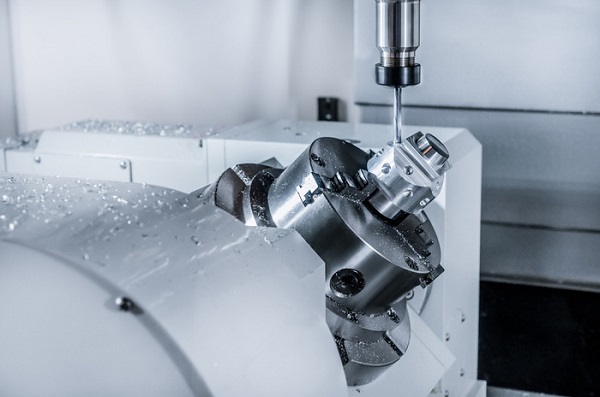
Look for a self-centering, pull-down vise for 5-axis machining. The critical term here is “pull-down”. As you tighten the screw, a wedge mechanism converts horizontal force into vertical downward pressure, anchoring the stock firmly onto the parallels or machine bed. We use these with dovetail-style jaws. You machine a matching dovetail notch into the stock’s bottom, leaving only 2.5mm of material for the final operation. This setup allows a plier-grip with zero top-side interference. The result? Repeatable positioning within ±0.005mm without deforming the raw stock. It solves the “spring back” issue that ruins post-processing reaming operations on tightly toleranced bores.
6. What Is the Role of a Modular Boring System?
Boring bars are often the weakest link due to their length-to-diameter ratio. But a welded solid bar only gives you one diameter. That’s inefficient.
A precision modular boring system uses a base holder with various head extensions. The smarter systems use a cartridge insert with a vernier dial adjustment offering adjustments in 0.002mm increments along the diameter. The art of fine boring depends on chip evacuation. If the chips wrap around the tool, they scratch the newly-cut surface instantly. Through-coolant modular shanks solve this, blasting swarf away from the cutting zone. For high-temp alloys, use carbide shanks instead of steel for the boring extension. The density and rigidity dampen vibration dramatically. Think of it as tuning the natural frequency of the tool away from the chatter zone, ensuring roundness within 0.005mm even at L/D ratios of 8:1.
7. Can a USB Digital Microscope Speed Up R&D?
Optical comparators are great for production floors, but during R&D and reverse engineering, you need documentation and portability. A traditional toolmaker’s microscope ties you to the bench.
A high-magnification (200x-250x) USB digital microscope is a rapid diagnostics powerhouse. We use it to check the cutting edge radius before a critical finish pass. A worn edge with 40µm of flank wear—invisible to the eye but catastrophic for aluminum—is flagged instantly. It turns a subjective “feel” when touching an edge with a fingernail into an objective digital record. For small batch runs, you can measure drilled hole edge break (chamfer uniformity) without moving the part to the QA lab. The lighting is the real trick here. Ring lights often wash out micro-level details. Polarized filters integrated into the scope lens remove glare, revealing micro-chipping that would otherwise compromise the next batch.
Conclusion
Mastering precision is a game of eliminating microscopic variables. By integrating a digital bore gauge for in-situ thermal checks, switching to shrink-fit holders to annihilate runout, and utilizing PVD-coated carbides as thermal shields rather than just cutting edges, you transform a machine shop into a high-precision laboratory. These tools aren’t expenses; they are the insurance policy against scrap and rework. Precision isn’t an accident of the machine; it’s a choice in tooling.
FAQ
What are the tools used in precision machining?
The core toolkit spans measurement (digital bore gauges, USB microscopes), workholding (pull-down 5-axis vises), tool holding (shrink-fit holders), and the cutting interfaces themselves (modular boring bars, diamond wheels, and coated inserts).
Which tool material is best for high-speed precision?
It depends on the workpiece. For high-temp alloys, nano-laminate AlTiN-coated micro-grain carbide is superior due to its thermal barrier properties. For non-ferrous metals like aluminum, sharp PCD (Polycrystalline Diamond) inserts are the gold standard.
How do you hold tight tolerances in deep boring operations?
Use a modular boring system with a carbide shank extension. The high stiffness of carbide moves the natural resonance frequency away from the cutting frequency, while through-tool coolant prevents chip scoring. Always adjust using a vernier dial cartridge in 0.002mm increments.
Is shrink-fit worth the investment for small diameter tools?
Absolutely. When tool diameters drop below 3mm, the runout reduction to <3 microns eliminates single-flute dominance, dramatically improving surface finish and preventing unpredictable tool breakage. It’s a statistical process control necessity.
Get projects quote with Moshijia Technology
Choosing the right tool is only half the battle; knowing how to sequence them for complex geometries is where true value lives. At Moshijia Technology, we don’t just machine parts—we engineer the process around them, committing to zero-concession quality output. Ready to move your project from a tight tolerance to a delivered reality? Reach out for a transparent, technical quote tailored to your critical specifications.