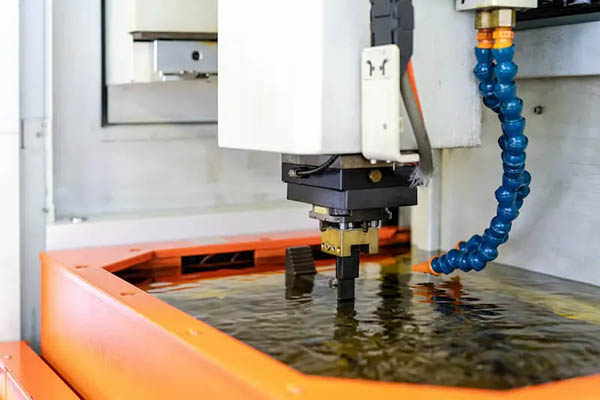
Discover how electric discharge machining (EDM) solves tough manufacturing challenges, from cutting ultra-hard metals to achieving tight tolerances.
What is Electric Discharge Machining?
Modern manufacturing moves fast. Engineers face tough limits when using standard milling machines. Hard metals like titanium or carbide wear down cutting tools quickly.
Deep, sharp internal corners are almost impossible to cut with spinning round drills. Delicate parts bend under the force of physical tools.
If you face these manufacturing roadblocks, electric discharge machining (EDM) offers a reliable solution. It is a non-traditional machining method that uses electrical thermal energy to shape metal parts. Instead of physical force, this method melts or vaporizes metal using high-frequency electrical sparks.
How EDM Works
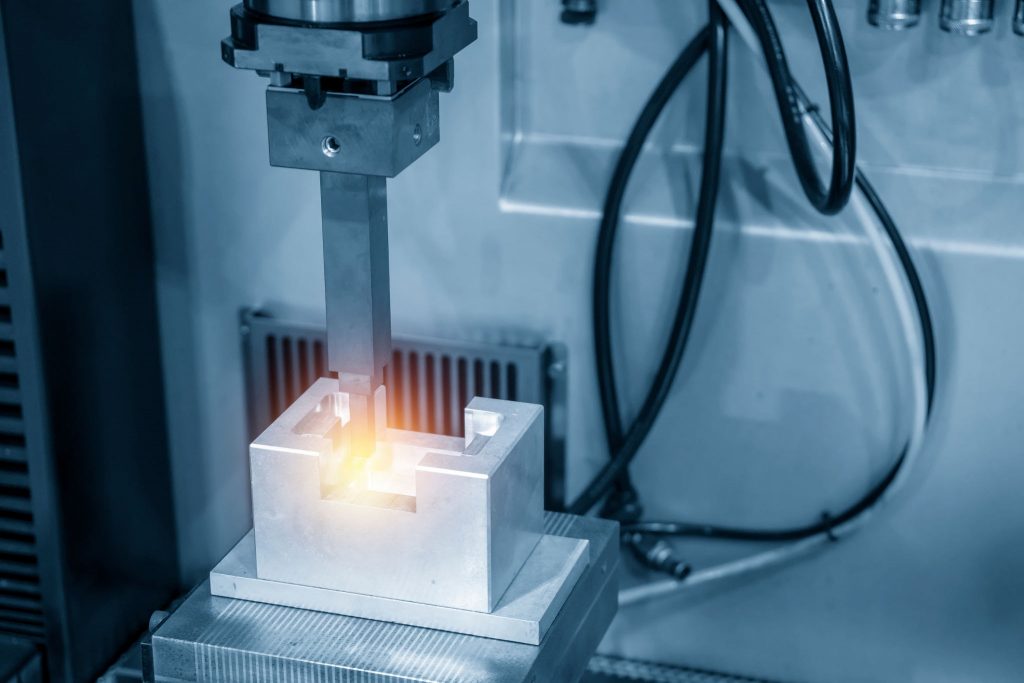
The core concept behind EDM is simple. An electrical power supply creates rapid, controlled spark discharges between a tool and a metal workpiece.
These sparks travel through a liquid called dielectric fluid (a special non-conductive liquid like deionized water or oil). The fluid acts as an electrical insulator until the voltage gets high enough. Once the voltage peaks, the fluid ionizes, and a spark jumps the gap.
Each spark generates intense heat, reaching temperatures between 8,000 to 12,000 degrees Celsius. This heat melts and vaporizes a tiny speck of metal. The dielectric fluid then cools the area and flushes the microscopic debris away.
Sinker vs Wire EDM
There are two primary types of electric discharge machining used in precision factories. The first is sinker EDM (also called die sinking or ram EDM). This style uses a custom-shaped copper or graphite electrode. The electrode acts as a 3D mold, slowly sinking into the workpiece to burn an identical negative cavity.
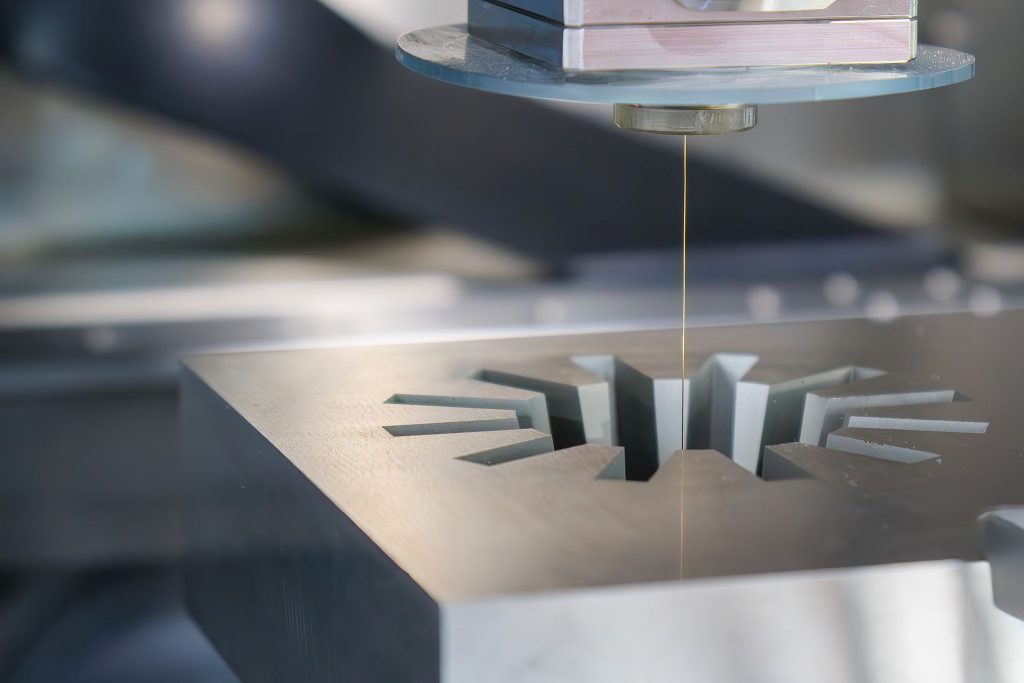
The second style is wire EDM. This method uses a thin, continuously moving brass or zinc-coated wire as the electrode. The wire acts like an incredibly precise band saw, slicing clean lines through thick metal plates.
1. Machining Ultra-Hard Materials
Conventional milling depends on physical hardness. The cutting tool must be harder than the workpiece, or the tool will dull, chip, or break. This makes cutting hard materials like tungsten carbide, hardened tool steel, or aerospace-grade titanium difficult and costly.
With electric discharge machining, material hardness is not a limiting factor. The process uses thermal energy to erode metal rather than physical force. A soft copper electrode can easily cut through the hardest steel alloys.
Material Hardness Limit:
[Traditional Milling] ──► Limited to softer metals (or needs expensive carbide tools)
[EDM Process]         ──► No hardness limit (cuts Tungsten Carbide, Titanium, Inconel)
In mold-making, parts are often heat-treated first to achieve maximum hardness. Machining these hardened steels with standard mills causes severe tool wear. EDM cuts through hardened tool steels (such as H13 or D2) at 60+ HRC (Rockwell Hardness C) with the exact same ease as soft aluminum. This eliminates tool wear concerns and lowers tooling costs.
2. High Precision and Tight Tolerances
Standard cutting tools deflect or bend slightly under high pressure. This physical deflection introduces tiny errors in accuracy. High-speed spindles also generate heat, causing metals to expand and ruin critical dimensions.
EDM does not use physical contact. There is no force pushing against the part, eliminating tool deflection errors. The dielectric fluid constantly cools the machining zone, keeping temperatures uniform.
| Machining Method | Average Achievable Tolerance | Minimum Radius |
| Standard CNC Milling | ±0.001 inches (0.025 mm) | 0.015 inches (0.38 mm) |
| Precision EDM | ±0.0001 inches (0.0025 mm) | 0.001 inches (0.025 mm) |
Because of this stability, EDM can easily hold tolerances as tight as ±0.0001 inches (0.0025 mm). This extreme precision is a major asset for medical device manufacturers making microscopic surgical tools.
3. Cutting Complex Geometries
Standard rotary tools cannot cut sharp internal corners. A round end mill will always leave a radius equal to half its diameter. If a blueprint requires a sharp 90-degree internal corner, traditional milling cannot deliver it.
Internal Corner Profiles:
Conventional Mill:  ( )  <-- Always leaves a round corner radius
EDM Electrode:     [  ]  <-- Creates a perfectly sharp internal 90-degree corner
Electric discharge machining handles complex shapes with ease. Wire EDM can cut thin slots down to the width of the wire itself—often as small as 0.004 inches (0.1 mm).
Sinker EDM can burn complex 3D shapes, deep hexagonal cavities, and blind keyways directly into solid steel. It is highly valued in the mold-making industry for creating intricate plastic injection molds.
4. Zero Mechanical Stress
During traditional milling, the cutting tool applies physical force to shear away metal chips. This physical force leaves stress inside the raw material. Thin-walled parts or delicate structures can easily bend, warp, or crack under this pressure.
EDM is a completely non-contact machining process. The electrode never actually touches the workpiece. A tiny spark gap of a few microns separates the two parts at all times.
Because there is no physical contact, there is zero mechanical stress. Engineers can safely machine thin-walled structures, fragile combs, and miniature brackets. This makes EDM highly reliable for delicate aerospace sensors and medical implants.
5. Superior Surface Finish
Standard milling leaves tool marks on the metal surface. These ridges require manual sanding, tumbling, or polishing to smooth out, adding extra production time and labor costs.
EDM leaves a highly uniform, crater-like texture on the metal. By adjusting the electrical spark parameters, operators can switch from fast, rough cuts to ultra-fine finishing passes.
EDM Finishing Phases:
[Roughing Pass]   ──► High energy, fast metal removal, rougher texture
[Finishing Pass]  ──► Low energy, high frequency, smooth satin finish (Ra < 0.2 μm)
During the finishing pass, low-energy, high-frequency sparks produce a smooth, satin finish. Surface roughness can reach values below Ra 0.2 μm (8 micro-inches). This smooth finish reduces or entirely eliminates the need for manual polishing.
6. Wide Material Compatibility
Some manufacturing processes only work on specific alloys. EDM is highly versatile because its only requirement is that the material must be electrically conductive.
As long as a material can conduct electricity, EDM can machine it. This includes common metals and advanced, high-performance alloys:
- Inconel and Hastelloy: Tough nickel superalloys used in jet engines.
- Titanium Alloys: High-strength, biocompatible metals used in bone implants.
- Graphite and Silicon: Used in semiconductors and specialty tooling.
- Conductive Ceramics: Advanced materials used in extreme-heat environments.
This broad compatibility gives product designers the freedom to choose the best material for their application, without worrying if it is too hard or difficult to machine.
7. Machining Post-Heat Treatment
In traditional manufacturing, parts are typically machined while soft, then sent out for heat treatment to harden them. However, heat treatment often causes the metal to warp or distort slightly.
Traditional Workflow:
[Machine Soft Metal] ──► [Heat Treatment] ──► [Warping/Distortion] ──► [Scrap or Fix]

EDM Workflow:
[Heat Treatment] ──► [Hardened Metal] ──► [EDM Precision Cutting] ──► [Perfect Part]
Using EDM, you can change this workflow. You can heat-treat the raw metal block first to its final hardness, then machine the tight-tolerance features using EDM. Because the metal is already hardened, there is no risk of post-machining warping. This ensures the final part remains perfectly straight and within spec.
Limitations of EDM
While EDM is highly versatile, it is not the best choice for every project. Understanding its limitations helps engineers make smart manufacturing decisions.
- Lower Material Removal Rate: EDM is slower than traditional CNC milling. It removes material microscopic speck by microscopic speck. It is best used for high-precision, intricate details rather than bulk material removal.
- Conductive Materials Only: Non-conductive materials like plastics, wood, glass, and standard ceramics cannot be machined using EDM.
- Heat-Affected Zone (HAZ): The intense heat from the sparks leaves a microscopic recast layer on the cut edge. This thin layer can be brittle and may require a quick chemical or mechanical clean-up on highly stressed aerospace parts.
Summary of EDM Benefits
To help you choose the right process for your project, here is a quick comparison of EDM versus traditional CNC milling:
| Feature | Electric Discharge Machining (EDM) | Traditional CNC Milling |
| Primary Mechanism | Thermal erosion (electrical sparks) | Mechanical shearing (rotating cutters) |
| Material Hardness | No limit (must be conductive) | Limited to softer/unhardened materials |
| Mechanical Force | Zero contact, zero force | High cutting force, potential part bending |
| Corner Radius | Extremely sharp (down to 0.001″) | Limited by tool radius (usually >0.015″) |
| Processing Speed | Slower, high-precision finishing | Fast, high-volume material removal |
Frequently Asked Questions
Is electric discharge machining more expensive than CNC milling?
Yes, EDM generally has a higher hourly operating cost because the machines run slower and the electrodes wear out and must be replaced. However, for hard metals, complex shapes, or delicate parts, EDM often lowers overall costs by reducing tool breakage, scrap parts, and secondary polishing steps.
Can wire EDM cut tapered or angled surfaces?
Yes. Modern multi-axis wire EDM machines can tilt the wire guide assemblies independently. This allows the machine to cut complex tapers, conical shapes, and different profiles on the top and bottom of a metal plate.
What is the “recast layer” in EDM machining?
The recast layer (or white layer) is a microscopic zone of metal on the cut surface that melted during the spark discharge but was not flushed away by the dielectric fluid. It cools rapidly and hardens. In critical aerospace components, this brittle layer is typically removed using a light chemical etch or gentle polishing.
How does electrode wear affect sinker EDM accuracy?
The electrical sparks wear down the copper or graphite electrode over time. To maintain high accuracy, CNC programmers use a “roughing electrode” to remove the bulk of the metal, followed by a brand-new “finishing electrode” to burn the final, precise details.
Get Projects Quote with Moshijia Technology
Need high-precision EDM parts for your next project? At Moshijia Technology, we provide professional wire EDM and sinker EDM services alongside high-speed CNC machining.
Whether you need complex mold cavities, ultra-thin aerospace parts, or micro-surgical tools, our engineering team can help. Upload your CAD files today to get a fast, accurate manufacturing quote.