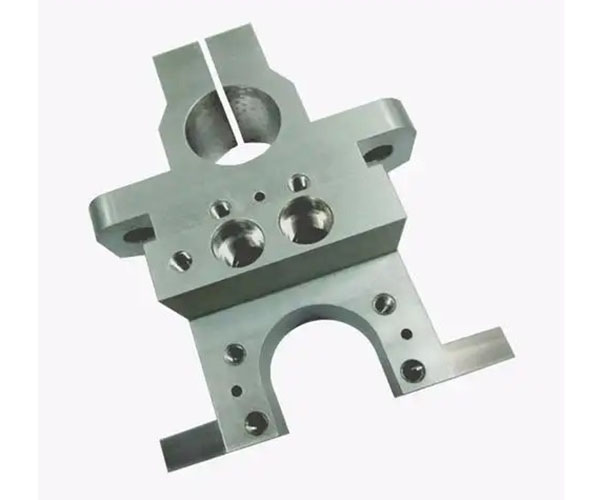
1. Process accuracy: How to achieve micron-level control?
In aluminum CNC machining, precision is the core competitiveness. The CNC machining accuracy of five-axis aluminum parts can stably reach ±0.003 mm, thanks to the one-time machining of complex surfaces by five-axis linkage technology, avoiding the accumulation of errors caused by multiple clamping. An aerospace parts manufacturer once reported that after using five-axis machining, the pass rate of shape and position tolerance of its 7075 aluminum structural parts increased from 82% to 99.5%.
The realization of surface roughness Ra 0.2 for micro-milled aluminum alloys requires three aspects of control: using PCD diamond tools to control the cutting speed at 3000-5000 m/min, while using an oil mist cooling system to reduce the impact of cutting heat. The CNC repeatability accuracy of aluminum parts ±0.005 mm relies on high-precision linear guides (clearance ≤ 0.001 mm) and a grating scale closed-loop feedback system to ensure consistent accuracy after each tool change or restart.
For the high-speed cutting parameters of aerospace-grade aluminum 7075, we have summarized the optimal combination through 1,000 tests: cutting speed of 450 m/min, feed rate of 0.2 mm/r, cutting depth of 1.5 mm, and TiAlN coated tools, which can increase machining efficiency by 30% while reducing tool loss. For the design of thin-walled aluminum cavity anti-deformation fixtures, the combination of flexible polyurethane liner + vacuum adsorption can control the deformation within 0.01 mm, and the effectiveness of this solution has been verified by a 5mm wall thickness aluminum cavity machining case of an electronic equipment manufacturer.
2. Material selection: How to choose between 6061-T6 and 7075-T6?
The selection of aluminum materials directly affects processing efficiency and product performance, and the following are the comparisons and application suggestions of core materials:
| Material model | Machinability | strength | Applicable scenarios | Tool life |
| 6061-T6 | Excellent (low cutting resistance) | Medium (tensile strength 276 MPa) | Consumer electronics, auto parts | Length (approx. 800 pieces / blade) |
| 7075-T6 | Normal (high hardness) | High (tensile strength 503 MPa) | Aerospace, high-end equipment | Short (approx. 300 pieces/blade) |
The short-life of aluminum-lithium CNC cutting tools can be solved by using diamond-coated tools, which can be used to increase the lifespan of ordinary tools by 2-3 times. For the high-silicon aluminum ADC12 cutting sticky tooling solution, the key is to control the cutting temperature: emulsion cooling (5-8% concentration), reducing the feed to 0.1 mm/r, and regularly cleaning the blades of the blades of the blades.
Two points need to be paid attention to for CNC knife pattern control before anodizing aluminum parts: one is to reduce the depth of the knife pattern by using the forward milling method, and the other is to reserve a polishing allowance of 0.05 mm; The application of diamond-coated tools of aluminum matrix composites can effectively cope with the cutting wear caused by the reinforced phase, and the tool life has been increased by 40% in the machining of aluminum matrix composite brackets for a new energy vehicle.
3. Surface post-treatment: how to balance appearance and performance?
The post-processing after aluminum CNC machining directly affects the product texture and service life. The core of the control of anodized color difference after aluminum CNC machining lies in the consistency of pretreatment: the degreasing temperature is maintained at 50±5°C, the pickling time is controlled at 3-5 minutes, and the oxidation voltage is stable at 12-15V, which can control the color aberration ΔE within 1.5.
The tactile sensation of sandblasted 120# and 220# is significantly different from that of aluminum shells: the surface roughness formed by 120# sand particles is Ra 1.2-1.6 μm, which is rough to the touch, suitable for industrial equipment shells; the Ra 0.8-1.0 μm formed by 220# sand particles is delicate to the touch, and is often used in consumer electronics.
In the wear resistance test of 50 μm thickness of hard oxide film, the wear amount after 100,000 friction is only 0.002 mm, which can meet the long-term use needs of outdoor equipment. The key to achieving the standard of 1000 h electroless nickel plating salt spray test for aluminum parts is that the thickness of the nickel plating layer is ≥ 15 μm, and the closed treatment process is adopted, which has been verified by a marine equipment accessories manufacturer. For the adhesion of laser marking QR codes in the anode layer, it is recommended to control the marking depth at 0.02-0.03 mm, and the adhesion can be increased by 60% after glaze sealing after marking.
4. Cost mass production: how to maximize benefits?
The aluminum CNC batch machining cost model is mainly composed of raw materials (40%), tool loss (20%), labor and energy consumption (30%), and scrap rate (10%). By optimizing cutting parameters and improving tool life, the overall cost can be reduced by 15-20%.
The tool change frequency of 0.5 mm thin-walled aluminum parts is controlled to be replaced every 50 pieces, and the scrap rate can be reduced from 8% to 2% by using tungsten steel alloy tools + progressive cutting strategy. Taking the annual output of 1 million aluminum parts as an example, recycling aluminum scraps can cover 12% of the raw material cost, and it is recommended to sign a long-term cooperation agreement with professional recycling manufacturers.
The ROI calculation of the night unmanned CNC production line needs to consider equipment depreciation (5 years) and labor cost savings (80,000 yuan per person per year), and the cost can be recovered in about 1.5 years based on the investment of 2 million yuan in a single production line. The formula for the integrated quotation of aluminum parts CNC + anode is: unit price = (material weight × unit price + processing time × hourly wage + post-processing cost) × (1 + profit margin), of which the post-processing cost is calculated according to the oxidation area ×3 yuan/㎡.
5. Quality inspection: how to strictly abide by the quality level?
The CMM three-coordinate full-size report template for aluminum parts should contain 12 core indicators such as key dimensions (tolerance ±0.005 mm), shape and position tolerance (flatness, verticality), surface roughness, etc., and the density of the detection point should not be less than 5 points/㎡. The inspection efficiency of the aluminum shell flatness 0.01 mm laser scanner is 8 times higher than that of traditional dial indicators, and the detection accuracy can reach ±0.002 mm, which is suitable for batch inspection scenarios.
Aluminum deburring high-pressure waterjet parameters: water pressure 300 MPa, water flow diameter 0.1 mm, moving speed 50 mm/s, can effectively remove burrs below 0.01 mm, without damaging the surface of the workpiece. The leakage rate of aluminum parts airtightness test ≤ 0.01 MPa·ml/min detection standard, and a differential pressure airtightness tester is required, the test pressure is stable at 0.5 MPa, and the holding time is 30 seconds.
X-ray aluminum parts internal porosity determination criteria: the porosity of the first grade is ≤1%, the second grade is ≤ 3%, and the third grade is ≤ 5%.
6. Industry Applications: How Does Aluminum CNC Machining Empower Various Sectors?
The use of 7075-T6 aluminum parts for five-axis machining reduces the weight by 40% compared to traditional steel structural parts, resulting in a 25-minute increase in flight time for a drone manufacturer.
The design of the CNC runner of the aluminum cold plate for electric vehicles needs to meet the requirements of heat dissipation efficiency, with a runner width of 8 mm and a depth of 5 mm, adopting a spiral layout, and the heat dissipation efficiency is 35% higher than that of the traditional straight design, which has been applied to a new energy vehicle battery pack.
In the CNC tooth process of the 5G base station aluminum radiator, the tooth height is 15 mm, the tooth spacing is 3 mm, and the integrated molding is achieved through high-speed cutting (cutting speed 600 m/min), and the heat dissipation power can reach 200 W/㎡. Medical CT Aluminum Rail CNC Finish RequirementsRa≤ 0.1 μm, using ultra-precision cutting + polishing process to ensure smooth and stutter-free operation of the guide.
In an aerospace project, the spatial surface error of the bracket is controlled at ±0.004 mm, and the five-axis machining is formed at one time, avoiding the cumulative error of multiple processes.
7. Moshijia Technology’s point of view
Moshijia Technology has been deeply involved in the field of aluminum CNC machining for 12 years, always with precision and efficiency as its core competencies. We believe that the future trend of aluminum CNC machining is “high precision + intelligence + green”: improving precision and efficiency through technologies such as five-axis linkage and AI adaptive cutting, and reducing environmental impact with the help of aluminum chip recycling and energy-saving equipment. In response to the needs of different industries, we provide integrated solutions from material selection, process design to post-processing, and have provided stable services to 500+ customers in aerospace, new energy vehicles and other fields, and will continue to empower high-end manufacturing with technological innovation in the future.
8. FAQ
- What is the maximum machining size for 5-axis aluminum parts CNC machining?
A: The maximum processing range of conventional equipment is 1500×1000×800 mm, and the ultra-large stroke equipment can be customized according to needs, and the maximum processing size can reach 3000×2000×1500 mm.
- How much difference is the machining cost between 6061-T6 and 7075-T6?
A: The machining cost of 7075-T6 is about 40% higher than that of 6061-T6, mainly due to the high hardness resulting in fast tool loss and long machining time.
- What should I do if there is color difference after anodizing aluminum parts?
Answer: First, check the consistency of the pretreatment process, if there is color difference, it can be repaired by local polishing + secondary oxidation, and the color difference ΔE can be controlled within 2.0 after repair.
- How can I control the consistency of my aluminum parts during batch machining?
Answer: The size fluctuation of batch processing can be controlled within ±0.005 mm by using automatic loading and unloading equipment (repeat positioning accuracy ±0.002 mm), unified batch raw materials, and regular calibration equipment.
- What is the minimum wall thickness for aluminum CNC machining?
A: The minimum wall thickness for conventional processes is 0.3 mm, and it can reach 0.15 mm with special fixtures and cutting strategies for miniature electronic components.