Choosing the wrong metal thickness can ruin a manufacturing project. As a product engineer at Moshijia Technology, I see this mistake often. Designers frequently confuse gauge numbers with fixed dimensions. They assume 16 gauge steel is the same as 16 gauge aluminum. It is not. This error leads to weak parts, broken tooling, and wasted budgets.
A sheet metal gauge chart is your primary tool to avoid these costly mistakes. However, you must know how to read it correctly. This comprehensive guide will break down the essential facts about sheet metal gauges. We will look at how the system works, cover precise material conversions, and review real-world industrial applications.
2. Understanding Sheet Metal Gauge
A. Gauge System Explanation
The term gauge refers to a traditional unit of measurement for sheet metal thickness. Unlike millimeters or inches, gauge values do not use a standard linear scale. Instead, the system uses specific whole numbers to represent precise dimensions.
In this system, higher gauge numbers signify thinner sheets of metal. Conversely, lower gauge numbers signify thicker sheets of metal. For instance, a 10 gauge sheet is significantly thicker than a 20 gauge sheet.
To get the actual physical thickness, you must look up the number on a sheet metal gauge chart. These charts convert the arbitrary numbers into usable decimal inches or millimeters. Engineers and machinists use these charts daily to ensure production consistency.
B. Historical Context And Evolution
The gauge system started during the early days of industrial wire drawing and metal rolling. Early wire manufacturers would pull a metal rod through a series of progressively smaller sizing holes. Each pull through a hole was called a “draw.”
- One draw produced a thick wire (1 gauge).
- Ten draws produced a much thinner wire (10 gauge).
- Twenty draws produced an extremely fine wire (20 gauge).
As the metal rolling industry grew, factories adopted this same numbering logic for flat sheets. Over time, different regions and industries formalized these practices into distinct official standards.
In the United States, the federal government established official legal standards for standard metal sizing in 1893. Today, modern computerized manufacturing still relies on these historical numbers to maintain continuity with legacy engineering prints.
C. Common Sheet Metal Materials
Sheet metal fabrication utilizes a wide variety of elemental metals and advanced alloys. Each material possesses unique chemical properties, tensile strengths, and manufacturing behaviors. The three most prevalent materials in modern production are:
- Carbon Steel: This includes hot-rolled and cold-rolled variations. It is highly popular due to its low cost, excellent structural weldability, and structural rigidity.
- Stainless Steel: Typically utilized in the 300 and 400 series families. It offers exceptional corrosion resistance and high yield strength under thermal stress.
- Aluminum: Known for being lightweight, non-magnetic, and highly formable. Common alloys include 5052-H32 and 6061-T6.
Other specialized materials include copper, brass, and galvanized steel. Each of these materials requires distinct considerations during automated bending, laser cutting, and stamping operations.
3. The Gauge Number System
A. Numbering System Description
The standard gauge system uses consecutive integers, typically ranging from 3 gauge down to 38 gauge. It operates as an inverse scale rather than a direct linear measurement. This means there is no simple multiplier to convert a gauge number straight to millimeters in your head.
The steps between numbers are non-linear. The physical thickness difference between a 10 gauge and 11 gauge sheet is not the same as the difference between a 20 gauge and 21 gauge sheet. Because of this non-linear progression, web designers and product developers must reference an official sheet metal gauge chart during every phase of the design process.
B. Gauge And Thickness Relationship
To understand the inverse relationship clearly, look at how the decimal values drop as the gauge numbers rise. The mathematical progression is geometric, dating back to the historical wire-drawing steps.
Crucial Rule: Large gauge number = Thin metal sheet. Small gauge number = Thick metal sheet.
Let us look at a practical example using standard manufacturer’s steel to see this pattern in action:
- 3 Gauge: 0.2391 inches (6.07 mm)
- 10 Gauge: 0.1345 inches (3.42 mm)
- 16 Gauge: 0.0598 inches (1.52 mm)
- 22 Gauge: 0.0299 inches (0.76 mm)
As you can see, when the gauge number increases from 3 to 22, the actual physical thickness drops by more than 85%. Missing this distinction during component design can lead to massive mechanical failures.
C. Metric Versus American Variations
Global manufacturing uses two primary systems for defining sheet metal thickness: the metric system and the American gauge system.
[American Gauge System] ---> Uses arbitrary inverse numbers (e.g., 14 GA)
[Metric System]         ---> Uses direct physical dimensions (e.g., 1.5 mm)
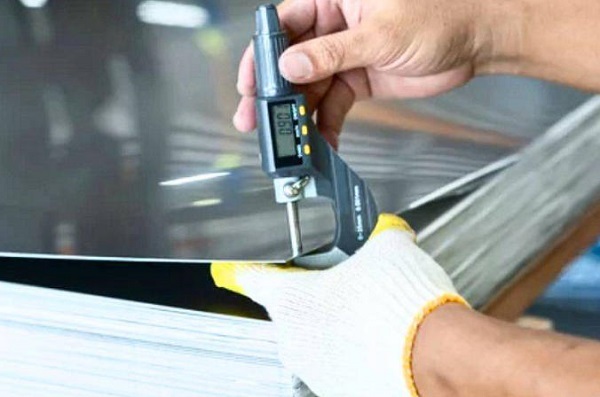
The metric system is straightforward. If a blueprint calls for a 2.0 mm steel plate, the inspector simply measures it with a digital caliper to check for 2.0 mm.
The American system uses the Standard Gauge and the Brown & Sharpe systems. These systems use distinct charts for ferrous and non-ferrous metals. For example, a 12 gauge steel sheet measures 0.1046 inches. However, a 12 gauge aluminum sheet measures 0.0808 inches.
At Moshijia Technology, we always recommend specifying the exact decimal thickness in millimeters or inches on your final CAD drawings. This eliminates all regional confusion between international suppliers.
4. Importance of Accurate Measurements
A. Impact On Material Properties
The specific thickness of a metal sheet directly influences its mechanical properties and performance. Weight, structural rigidity, and electrical conductivity all scale with thickness.
Weight calculations are vital for transport equipment and aerospace parts. Thicker sheets add structural mass, which increases fuel consumption.
Bending resistance also changes drastically with thickness. The rigidity of a flat sheet scales cubically with its thickness. This means doubling the thickness of a panel increases its stiffness by roughly eight times.
Thickness Factor: 1x ---> Rigidity: 1x
Thickness Factor: 2x ---> Rigidity: 8x
If your engineer selects 18 gauge instead of 16 gauge by mistake, the final product will flex much more than expected under load.
B. Incorrect Gauge Consequences
Using the incorrect gauge during manufacturing causes severe production problems. Here are three common issues:
- Tooling Damage: Placing a 12 gauge steel sheet into a press brake set up for 16 gauge steel can crack the forming die or overload the hydraulic system.
- Weld Burn-Through: If the assembly line receives 22 gauge metal instead of 18 gauge metal, the welding torches will melt straight through the joints, ruining the assembly.
- Assembly Interference: In precision enclosures, a variation of just 0.02 inches can prevent internal circuit boards from fitting into their designated mounting slots.
These mistakes lead to scrap metal, late delivery penalties, and unexpected retooling costs.
C. High Precision Applications
Many modern industries demand strict adherence to exact gauge specifications. In medical device manufacturing, surgical trays and equipment housings must use exact thicknesses to meet strict weight and sterilization standards.
The aerospace sector requires absolute precision to guarantee aircraft safety and weight optimization. Even a tiny weight deviation across a fuselage skin panel can compromise flight dynamics.
Automotive stamping lines also rely on highly uniform sheet thickness. This consistency ensures predictable energy absorption during vehicle crash tests, protecting passengers from impact forces.
5. Common Materials and Their Gauge Standards
A. Material Group Overview
You cannot use a single universal chart for every type of metal. Different metal groups use completely separate gauge standardizations.
Ferrous metals contain iron and are typically measured using the Manufacturers’ Standard Gage system. This system applies to standard carbon steel and galvanized sheets.
Non-ferrous metals do not contain iron. Aluminum and copper alloys are measured using the American Wire Gage (AWG) system, which is also known as the Brown & Sharpe scale. Because of these distinct systems, an identical gauge number will yield vastly different physical thicknesses across different metal groups.
B. Specific Material Standards
To ensure precise production, you must match your chosen material to its corresponding historical standard:
- Standard Steel: Uses the Manufacturers’ Standard Gage scale. This scale is based on a baseline weight of 41.82 pounds per square foot per inch of thickness.
- Stainless Steel: Uses the U.S. Standard Gauge scale. It is calculated using a baseline weight of 42.00 pounds per square foot per inch of thickness due to its higher density.
- Aluminum: Uses the non-ferrous Brown & Sharpe scale. This scale uses a distinct geometric progression that does not correlate with steel weight metrics.
Always verify that your quoting team and your raw material vendors are looking at the exact same standard chart before placing a production order.
C. Thickness Comparison Across Materials
To highlight the risk of cross-material confusion, let us look at how the actual thickness varies for a single gauge number across different metals.
The table below shows the decimal inch values for 16 Gauge across four common materials:
| Material Type | Gauge Standard Scale | Thickness (Inches) | Thickness (Millimeters) |
| Standard Carbon Steel | Manufacturers’ Standard | 0.0598 in | 1.52 mm |
| Stainless Steel | U.S. Standard Gauge | 0.0625 in | 1.59 mm |
| Galvanized Steel | Manufacturers’ Standard | 0.0635 in | 1.61 mm |
| Aluminum Alloy | Brown & Sharpe (AWG) | 0.0508 in | 1.29 mm |
Looking at the data, 16 gauge galvanized steel is nearly 25% thicker than 16 gauge aluminum. Designing an assembly under the assumption that these two materials are identical will result in misaligned parts.
6. How to Read a Sheet Metal Gauge Chart
A. Component Layout Analysis
A professional sheet metal gauge chart is organized as a multi-column reference table. The layout is designed to help you quickly cross-reference standard sizing numbers with actual physical measurements.
[Gauge Number] ---> [Carbon Steel (in/mm)] ---> [Stainless Steel (in/mm)] ---> [Aluminum (in/mm)]
The first column on the left always displays the standard integer Gauge Number. The subsequent columns are divided by material type.
Each material column contains two sub-columns: one for decimal inches and one for millimeters. Some advanced industrial charts also include an extra column showing the weight per square foot (lbs/ft²) or square meter (kg/m²), which is highly useful for shipping calculations.
B. Step-By-Step Chart Interpretation Guide
Follow these four steps to read a gauge chart correctly during your next engineering review:
- Identify the exact material: Determine if your part requires standard carbon steel, stainless steel, aluminum, or copper.
- Locate the required gauge number: Scan down the leftmost column to find the specific integer designated on your design draft.
- Move horizontally to the correct material column: Shift your eyes to the right until you reach the column that matches your selected material.
- Extract the physical dimensions: Note both the decimal inch and millimeter values. Use these exact dimensions to set up your CAD software and program your laser cutter.
C. Practical Field Tips
Here are three practical tips to avoid common measurement mistakes on the shop floor:
- Always check the material type twice: Never look at a steel chart if you are working with aluminum parts.
- Account for standard mill tolerances: Rolled sheet metal is rarely perfect. A standard 16 gauge steel sheet has an acceptable manufacturing tolerance window between 0.0538 and 0.0658 inches.
- Invest in a dedicated sheet metal gauge wheel: This round notched tool lets you quickly check sheet thickness on the shop floor. Simply slide the metal into the edge slots until you find a snug fit, then read the stamped gauge number.
7. Applications of Sheet Metal Gauge Charts
A. Industrial Usage Overview
Many major global industries rely heavily on standard gauge charts to keep their production lines running smoothly:
- Construction: Fabricators use 18 to 22 gauge galvanized steel to manufacture strong, weather-resistant HVAC ductwork and roofing panels.
- Automotive: Stamping plants use 14 to 20 gauge steel to form durable structural chassis components, hoods, and door panels.
- Aerospace: Component designers use thin 20 to 26 gauge aluminum alloys to build lightweight internal cabin brackets and external skin panels.
- Electronics: Precision engineers use 16 to 22 gauge aluminum and steel to construct robust computer server racks, control boxes, and shielding enclosures.
B. Real-World Project Examples
Let us look at two real-world design projects from our manufacturing work at Moshijia Technology to see how gauge selection works in practice.
Case Study 1: Outdoor Telecom Enclosure
An industrial client needed a durable, weather-resistant outdoor electrical enclosure. The box had to protect delicate electronics from vandalism and heavy rain without bending or flexing.
We selected 14 gauge stainless steel (0.0781 inches or 1.98 mm). This thickness provided excellent structural rigidity, allowed for clean watertight welds, and successfully prevented warping during the robotic bending process.
Case Study 2: Lightweight Desktop Computer Chassis
A consumer electronics company wanted a compact desktop computer case. The primary goals were low shipping weight and clean, sharp aesthetics.
We selected 18 gauge aluminum (0.0403 inches or 1.02 mm) for the internal bracket structure. For the outer cosmetic cover panels, we used 20 gauge aluminum (0.0320 inches or 0.81 mm). This combination kept the chassis incredibly light while ensuring it remained rigid enough to support internal cooling fans and power supplies.
C. Design And Manufacturing Integration
Integrating gauge chart data early in your CAD design flow prevents major downstream production issues. Modern 3D modeling programs require you to input an exact physical sheet thickness before you can use automated sheet metal bending tools.
If you input an arbitrary thickness value like 0.060 inches for an aluminum part, your model will not match real-world materials. The factory will have to use standard 16 gauge aluminum (0.0508 inches).
This difference changes the inner bend radius and the final flat layout calculations. By using correct chart dimensions from day one, your flat patterns will unfold perfectly, ensuring your parts fit together seamlessly on the assembly line.
8. Common Misconceptions About Sheet Metal Gauges
A. Clarifying Thickness Myths
The biggest myth in sheet metal fabrication is that a higher gauge number means a thicker sheet of metal. As we covered earlier, the system is completely inverted.
[Myth]     Higher Gauge = Thicker Material
[Reality]  Higher Gauge = Thinner Material
If a buyer orders 24 gauge steel expecting heavy-duty industrial plates, they will receive thin sheets that bend easily by hand. You must train your procurement teams to remember that as the gauge number goes up, the physical thickness goes down.
B. Gauge Versus Alternative Measurements
Another common issue is confusing sheet metal gauge numbers with completely different industrial sizing scales.
For example, the Plate Thickness system is used for heavy steel plates thicker than 3/16 of an inch. These thick plates are always measured using standard fractions of an inch or direct millimeters, never gauge numbers.
Additionally, never confuse sheet metal gauge with wire gauge or shotgun bore gauge. While they share historical roots, their underlying conversion tables are completely different. A 10 gauge wire chart does not match a 10 gauge steel sheet chart.
C. Industry Education Importance
As manufacturing becomes more automated and globalized, clear technical education is more important than ever. Engineering schools often focus on theoretical design while spending little time on practical shop floor standards.
When new designers join a project, they often submit CAD files with impossible material thicknesses. Bridging this knowledge gap through clear documentation and reference charts saves time, lowers production costs, and improves communication between design teams and factories.
9. Comprehensive Sheet Metal Gauge Chart
Below is our master engineering reference table for standard production materials. It includes the four most common metals used across the B2B manufacturing sector. Save this table for quick access during your upcoming product planning reviews.
| Gauge No. | Carbon Steel (in) | Carbon Steel (mm) | Stainless Steel (in) | Stainless Steel (mm) | Galvanized Steel (in) | Galvanized Steel (mm) | Aluminum (in) | Aluminum (mm) |
| 3 | 0.2391 | 6.07 | 0.2500 | 6.35 | – | – | 0.2294 | 5.83 |
| 4 | 0.2242 | 5.69 | 0.2344 | 5.95 | – | – | 0.2043 | 5.19 |
| 5 | 0.2092 | 5.31 | 0.2188 | 5.56 | – | – | 0.1819 | 4.62 |
| 6 | 0.1943 | 4.94 | 0.2031 | 5.16 | – | – | 0.1620 | 4.11 |
| 7 | 0.1793 | 4.55 | 0.1875 | 4.76 | – | – | 0.1443 | 3.67 |
| 8 | 0.1644 | 4.18 | 0.1719 | 4.37 | 0.1681 | 4.27 | 0.1285 | 3.26 |
| 9 | 0.1495 | 3.80 | 0.1563 | 3.97 | 0.1532 | 3.89 | 0.1144 | 2.91 |
| 10 | 0.1345 | 3.42 | 0.1406 | 3.57 | 0.1382 | 3.51 | 0.1019 | 2.59 |
| 11 | 0.1196 | 3.04 | 0.1250 | 3.18 | 0.1233 | 3.13 | 0.0907 | 2.30 |
| 12 | 0.1046 | 2.66 | 0.1094 | 2.78 | 0.1084 | 2.75 | 0.0808 | 2.05 |
| 13 | 0.0897 | 2.28 | 0.0938 | 2.38 | 0.0934 | 2.37 | 0.0720 | 1.83 |
| 14 | 0.0747 | 1.90 | 0.0781 | 1.98 | 0.0785 | 1.99 | 0.0641 | 1.63 |
| 15 | 0.0673 | 1.71 | 0.0703 | 1.79 | 0.0710 | 1.80 | 0.0571 | 1.45 |
| 16 | 0.0598 | 1.52 | 0.0625 | 1.59 | 0.0635 | 1.61 | 0.0508 | 1.29 |
| 17 | 0.0538 | 1.37 | 0.0563 | 1.43 | 0.0575 | 1.46 | 0.0453 | 1.15 |
| 18 | 0.0478 | 1.21 | 0.0500 | 1.27 | 0.0516 | 1.31 | 0.0403 | 1.02 |
| 19 | 0.0418 | 1.06 | 0.0438 | 1.11 | 0.0456 | 1.16 | 0.0359 | 0.91 |
| 20 | 0.0359 | 0.91 | 0.0375 | 0.95 | 0.0396 | 1.01 | 0.0320 | 0.81 |
| 21 | 0.0329 | 0.84 | 0.0344 | 0.87 | 0.0366 | 0.93 | 0.0285 | 0.72 |
| 22 | 0.0299 | 0.76 | 0.0313 | 0.80 | 0.0336 | 0.85 | 0.0253 | 0.64 |
| 24 | 0.0239 | 0.61 | 0.0250 | 0.64 | 0.0276 | 0.70 | 0.0201 | 0.51 |
| 26 | 0.0179 | 0.45 | 0.0188 | 0.48 | 0.0217 | 0.55 | 0.0159 | 0.40 |
| 28 | 0.0149 | 0.38 | 0.0156 | 0.40 | 0.0187 | 0.47 | 0.0126 | 0.32 |
| 30 | 0.0120 | 0.30 | 0.0125 | 0.32 | 0.0157 | 0.40 | 0.0100 | 0.25 |
10. Conclusion
Mastering the sheet metal gauge chart is essential for any professional working in product design or industrial manufacturing. Using this inverse scale correctly helps you prevent assembly errors, avoid tool damage, and keep your production costs under control.
Always remember that gauge values change depending on the material type. For best results, clearly list both the gauge number and the exact decimal millimeter dimensions on your technical drawings. This practice keeps your documentation clear and ensures consistent quality from prototype to final production.
11. FAQ
Is 16 gauge steel thicker than 18 gauge steel?
Yes. The sheet metal gauge scale is an inverse system. Smaller gauge numbers represent thicker material sheets. A 16 gauge steel sheet measures approximately 0.0598 inches (1.52 mm), while an 18 gauge steel sheet measures 0.0478 inches (1.21 mm).
Why does the same gauge number give different thicknesses for steel and aluminum?
Steel and aluminum use completely separate historical standardizing scales. Steel thickness is based on the Manufacturers’ Standard Gage scale for ferrous metals. Aluminum thickness is determined by the Brown & Sharpe (AWG) scale for non-ferrous metals. Always use the specific column for your material on the gauge chart.
What happens if I design a part with a non-standard sheet metal gauge?
If you specify a non-standard thickness, raw material vendors will not have it in stock. The fabrication factory will have to custom-grind or machine standard plates down to your specified size. This non-standard step drastically increases production lead times and adds significant unnecessary costs to your project budget.
How do sheet metal material tolerances affect my final product assembly?
Every sheet metal batch from a rolling mill comes with small thickness variations. For instance, standard 14 gauge steel can legally vary by a few thousandths of an inch. If your design features tight interlocking joints or slots, you must incorporate these standard material tolerance windows into your 3D CAD models to prevent fitment issues during final assembly.
Get projects quote with Moshijia Technology
Ready to bring your next sheet metal project to life? Work with the manufacturing experts at Moshijia Technology. Our engineering team reviews every design print to verify material gauge selections, tolerances, and bend radii before production begins. We operate advanced laser cutters, precision press brakes, and automated stamping lines to deliver high-quality custom metal parts with fast turnaround times.