Introduction
Precision machining directly benefits seven core industries more than others. These sectors share three traits: extreme tolerance demands, high-cost failure risks, and rigid regulatory standards. Based on our work at Moshijia Technology, the top beneficiaries are Aerospace, Medical Devices, Automotive, Electronics, Defense, Energy, and Robotics. This article breaks down why each industry relies on this process, the specific value it creates, and how to prioritize your market focus.
1. Aerospace: Where Microns Save Lives
Extreme Tolerances and Material Rules
The aerospace industry cannot compromise. Precision machining produces flight-critical parts where a ±0.0005-inch tolerance is standard. Components face extreme temperatures, vibration, and pressure cycles.
- Key parts: Turbine blades, fuel system nozzles, landing gear fittings.
- Materials: Inconel, Titanium Grade 5, 7075 Aluminum.
- Data point: The global aerospace precision machining market is projected to grow at 6.8% CAGR (2024–2030).
Why it’s rigid: A single out-of-spec bushing can ground a fleet. We once recertified a turbine housing where a 0.002-inch bore deviation caused a 15% efficiency drop. This industry demands CMM inspection reports for every batch.
2. Medical Devices: Biocompatibility and Zero Defects
Regulatory Compliance Drives Demand
In medical manufacturing, precision is patient safety. Precision machining creates implants and surgical tools that must pass FDA and ISO 13485 audits. Surface finishes often require Ra 0.4 µm or better to prevent bacterial adhesion.
| Component | Material | Typical Tolerance |
|---|---|---|
| Hip stem | Ti-6Al-4V | ±0.0002″ |
| Bone screw | 316L SS | ±0.0005″ |
| Spinal cage | PEEK | ±0.001″ |
Real-world impact: A 2023 study showed that 92% of orthopedic implant failures trace to surface finish or micro-cracks from poor machining. For Moshijia Technology, medical clients prioritize repeatability over speed. One batch of 500 spinal screws must match the first.
3. Automotive: Performance and Mass Production
Balancing Speed with Sub-10µm Accuracy
The automotive sector uses precision machining differently. Here, volume meets exacting standards. High-performance engines, EVs, and fuel systems need CNC-machined parts that function at over 8,000 RPM.
- High-volume parts: Piston pins, valve lifters, injector bodies.
- EV-specific: Battery terminals, motor shafts, gearbox housings.
- Key stat: A typical modern car contains over 200 precision-machined components.
Expert note: Unlike aerospace, automotive demands cost-per-part efficiency. At Moshijia Technology, we optimize cycle times using high-feed milling and live tooling lathes. For a client making EV rotor shafts, we reduced scrap by 12% while holding 6 µm roundness.
4. Electronics: Miniaturization Challenges
Micro-Machining for Shrinking Devices
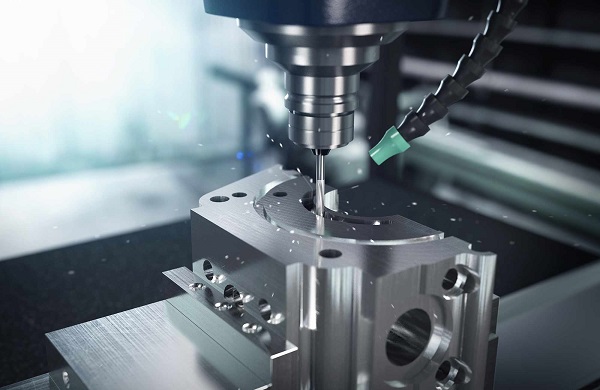
The electronics industry pushes precision machining to its physical limits. As devices get smaller, connectors and housings require micro-milling with tools as small as 0.2 mm diameter.
Key applications:
- Heat sinks for 5G base stations.
- Smartphone camera modules.
- Semiconductor test sockets.
The real challenge: Thermal expansion. A 10°C temperature shift can alter a micro-machined part by 3–5 microns – enough to fail a high-speed connector. Top electronics manufacturers enforce climate-controlled cells (20°C ±0.5°C) for critical runs.
5. Defense and Military: Durability Under Stress
Uncompromised Reliability Standards
Defense applications require precision machining for systems that must work after shock, sand, and saltwater exposure. Tolerances are tight, but material certification (e.g., MIL-SPEC) is non-negotiable.
- Typical parts: Receiver rails, periscope housings, missile guidance rings.
- Material focus: 4340 steel, 6061-T6 armor-grade, duplex stainless.
- Industry fact: Over 70% of defense component rejections come from incorrect edge breaks or surface decarburization – not dimension errors.
Our experience: We machined a batch of drone motor mounts from 17-4 PH stainless. The client needed H900 hardness (40 HRC) and full traceability back to the mill. Without in-process probing, meeting those specs at 200 units/month is impossible.
6. Energy: From Turbines to Tidal Power
High-Torque Components for Harsh Sites
The energy sector uses precision machining in both fossil and renewable systems. Wind, gas, and hydro turbines depend on large-diameter parts (up to 2 meters) with gear profiles accurate to ISO 8 or better.
| Energy Type | Machined Part | Critical Feature |
|---|---|---|
| Wind | Pitch bearing race | Roundness < 25 µm |
| Natural gas | Compressor impeller | 5-axis blade profile |
| Tidal | Shaft sleeve | Corrosion coating thickness |
| Nuclear | Fuel handling tool | Cleanliness (no embedded chips) |
Key insight: Energy clients prioritize long-life coatings and post-machining NDT (dye penetrant or ultrasonic). A poorly machined wind gearbox bearing can cause $50k+ per day in downtime.
7. Robotics and Automation: Repeatability at Speed
Zero Backlash for Consistent Motion
Robotics demands precision machining for joints, actuators, and end effectors. A robot’s repeatability (often ±0.02 mm) depends entirely on the accuracy of its machined mating surfaces.
- Common parts: Harmonic drive flex splines, linkage arms, sensor housings.
- Material choice: 7075 aluminum for arms, 4140 steel for shafts.
- Market data: The robotics machining market will exceed $4.5 billion by 2028.
Practical takeaway: Poorly machined robot components cause calibration drift. At Moshijia Technology, we map gear tooth profiles using gear testers to ensure backlash below 0.05 mm. This keeps collaborative robots accurate after millions of cycles.
8. Tool and Die: The Enabler Industry
Accuracy That Molds Other Parts
Tool and die is the hidden backbone. Precision machining creates molds, punches, and fixture plates that make other manufactured goods. If a mold is off by 0.001 inch, every injection-molded part inherits that error.
- Examples: Injection mold cores, stamping die buttons, inspection gauges.
- Required finishes: Ra 0.1 µm for plastic mold release.
- Steel types: P20, H13, A2 tool steel (heat-treated to 50-55 HRC).
Industry truth: Many “precision” part defects trace back to a worn or inaccurate tool. We grind punch and die clearances based on material thickness – for 1 mm steel, clearance stays at 0.1 mm per side. That’s experience, not a formula.
Conclusion
To decide where to focus your precision machining capabilities or supplier search, rank industries by tolerance criticality and failure cost. Aerospace and medical lead for strict regulations. Automotive and electronics reward volume with consistency. Defense and energy demand durability, while robotics requires dynamic accuracy. Tool and die is the silent enabler. All seven benefit – but for different reasons. Align your machining strategy to the industry’s real pain point, not just the part geometry.
Frequently Asked Questions (FAQ)
What is precision machining in simple terms?
It is a manufacturing process using CNC machines to cut metal or plastic to very tight tolerances, often within 0.001 inches or less.
Which industry requires the tightest precision machining tolerances?
The aerospace and medical industries regularly require ±0.0002 inches or tighter, especially for turbine blades and orthopedic implants.
Can precision machining be used for high-volume automotive parts?
Yes. Modern CNC lathes and mills run unattended for high volumes, but cycle time optimization is more critical here than in low-volume sectors.
How does Moshijia Technology ensure quality for defense parts?
We use in-process probing, certified material traceability, and CMM inspection to MIL-STD-883 standards. Every batch includes full documentation.
Is precision machining expensive for small electronics components?
Micro-machining has higher setup costs due to tooling and fixturing, but it is cost-effective for 500–10,000 unit runs where injection molding is impractical.
Get projects quote with Moshijia Technology
Need precision machining for aerospace, medical, or robotics components? Moshijia Technology delivers ISO 9001:2025 certified parts from prototype to production. Share your 3D file and tolerance callouts – we reply with a 48-hour quote and DFM feedback. [Contact our engineers directly] to start.