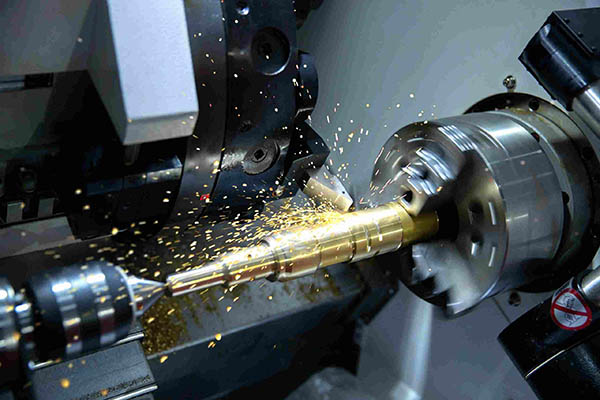
Avoid costly errors in precision CNC machining. Learn how to prevent tool wear, thermal expansion, and setup issues to cut scrap rates and boost shop efficiency.
Precision CNC machining is a game of microns. In this industry, a tiny mistake can turn an expensive aerospace alloy block into scrap metal. Many machine shops struggle with high scrap rates, missed tolerances, and slow cycle times. Often, these issues do not stem from bad machines. They come from small, overlooked mistakes in setup, programming, and tool selection.
As a product engineer at Moshijia Technology, I see these challenges every day. This guide covers the ten most common mistakes in precision cnc machining and shows you how to fix them.
1. Poor Tool Selection and Wear
Selecting the wrong tool or running a worn cutter ruins parts quickly. Many machinists try to use one general tool for too many different materials.
[Too-Long Tool Projection] ---> [High Deflection & Vibration] ---> [Poor Surface Finish & Tool Breakage]
Choosing the Wrong Tool
Using a tool meant for aluminum on stainless steel is a recipe for failure. Aluminum cutters have high helix angles and wide flutes to clear soft, sticky chips. Stainless steel requires stronger cutting edges, specific coatings like AlTiN (Aluminum Titanium Nitride), and fewer flutes to handle heat and hardness. Matching the tool material, coating, and geometry to your specific workpiece is critical.
Ignoring Tool Deflection
Long, thin end mills bend under cutting forces. This bending is called tool deflection. It causes taper on vertical walls and ruins dimensional accuracy.
To minimize deflection, always use the shortest tool possible. The formula for tool deflection shows that deflection increases with the cube of the tool’s overhang length:
$$\text{Deflection} \propto \frac{L^3}{d^4}$$
Where:
- $L$ is the overhang length
- $d$ is the tool diameter
Keeping your tools short and rigid is essential for tight tolerances.
Neglecting Tool Wear Monitoring
Waiting for a tool to break before changing it is highly inefficient. Worn tools increase cutting forces, generate excess heat, and leave a poor surface finish. Implement a tool life tracking system based on machining time or part count. Inspect cutting edges under a microscope regularly to catch chipping before it damages a part.
2. Incorrect Cutting Parameter Settings
Running a machine with incorrect speeds and feeds wastes time and destroys tooling. Many operators rely on guesswork instead of calculated data.
       [FEED RATE TOO LOW]                    [FEED RATE TOO HIGH]
  Work hardening & friction heat         Excessive load & tool breakage
            |                                      |
            v                                      v
   (Poor tool life & finish)              (Immediate part/tool damage)
Improper Speeds and Feeds
- Cutting Speed ($V_c$): The speed at which the tool edge cuts the material, measured in Surface Feet per Minute (SFM) or Meters per Minute (m/min). Too high burns the tool; too low causes rubbing.
- Feed Rate ($F$): The distance the tool advances per revolution or per minute. Too high breaks the cutter; too low causes work hardening in metals like titanium and stainless steel.
To calculate the correct spindle speed ($N$ in RPM) and feed rate ($F_m$ in inch/min), use these standard formulas:
$$N = \frac{12 \times V_c}{\pi \times D}$$
$$F_m = N \times f_z \times z$$
Where:
- $D$ is the cutter diameter (inches)
- $f_z$ is the feed per tooth (inch/tooth)
- $z$ is the number of flutes
Incorrect Depth of Cut
Taking too deep of a cut (axial depth $a_p$) overloads the spindle and causes severe chatter. Taking too shallow of a cut reduces efficiency and causes the tool to rub rather than slice, which heats up the part. Use a balanced depth of cut based on the tool manufacturer’s recommendations.
3. Unstable Workpiece Clamping
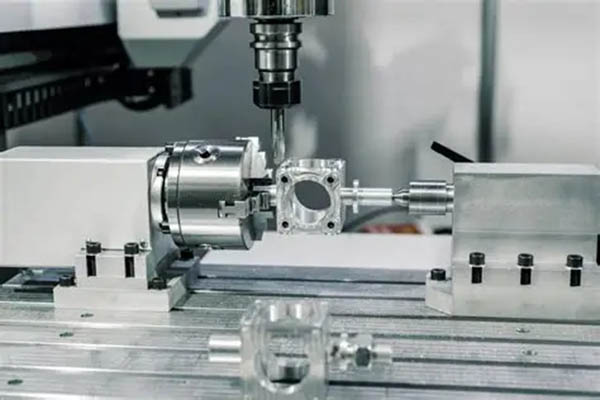
Even the best CNC program cannot save a part that moves during machining. Unstable workholding causes vibration, inaccurate dimensions, and safety hazards.
| Clamping Issue | Direct Result | Solution |
| Over-tightening | Part deformation and warping | Use torque wrenches; use soft jaws |
| Too few clamp points | Part vibration and chatter | Add support jacks; design custom fixtures |
| Incorrect clamping force | Part throws or slips | Calculate holding force; use hydraulic vises |
Part Warping from Clamping
Applying too much force with a vise can bend thin-walled parts. When you release the vise after machining, the part springs back to its original shape, making the machined surfaces flat no longer. For delicate geometries, use custom soft jaws that contour to the part shape, distributing the clamping pressure evenly.
4. Ignoring Thermal Deformation Effects
Machining generates intense friction heat. Metal expands when hot and contracts when cold. If you ignore this thermal behavior, your parts will fail inspection once they cool down.
Thermal Expansion of Materials
Different metals expand at different rates. Aluminum expands roughly twice as much as steel under the same temperature rise.
The formula for linear thermal expansion is:
$$\Delta L = \alpha \times L_0 \times \Delta T$$
Where:
- $\Delta L$ is the change in length
- $\alpha$ is the coefficient of thermal expansion
- $L_0$ is the original length
- $\Delta T$ is the temperature change
Controlling Shop Temperature
A precision machine shop must have climate control. If the ambient temperature swings by $10^\circ\text{C}$ ($18^\circ\text{F}$) between morning and afternoon, your machine casting and workpiece will expand, shifting your machine coordinates. Keep your shop at a steady temperature, typically around $20^\circ\text{C}$ ($68^\circ\text{F}$).
5. Poor Toolpath Planning
Inefficient toolpaths waste machine time, cause unnecessary tool wear, and create poor surface finishes.
[Traditional Toolpath] ---> Sharp 90-degree corners ---> Sudden load spikes ---> Chipped inserts
[Trochoidal Toolpath]  ---> Smooth circular loops    ---> Constant tool load ---> Long tool life
Avoiding Sharp Direction Changes
Standard toolpaths often force the cutter into sharp $90^\circ$ corners. This causes the tool to engage more material suddenly, spiking the cutting force and causing chatter. Use trochoidal milling or constant engagement toolpaths. These paths use smooth, circular motions to keep the tool load consistent.
Optimize CAM Settings
Configure your Computer-Aided Manufacturing (CAM) software to utilize high-speed machining (HSM) strategies. Keep the tool down on the part to minimize “air cutting” time. Ensure your lead-in and lead-out moves are smooth arcs rather than straight plunge steps to prevent witness marks on finished surfaces.
6. Lack of Process Verification
Running a new CNC program without verifying it first often leads to expensive crashes. Never trust a raw G-code file straight from CAM without testing.
Dry Run the Program
Before cutting metal, perform a dry run. Run the program in the air with the Z-axis offset elevated safely above the workpiece. This allows you to visually verify the tool movements, tool changes, and clearance heights without risking a collision.
Use CNC Simulation Software
Modern CAD/CAM suites offer robust machine simulation tools. Use them to check for interference between the spindle, tool holders, fixtures, and the machine enclosure. Simulating the toolpath helps catch errors before the machine spindle ever turns.
7. Improper Coolant Application
Coolant does more than keep things cool. It lubricates the cut, prevents built-up edge (BUE) on the tool, and flushes chips out of the cutting zone.
             [COOLANT DELIVERY METHODS]
             /                        \
            v                          v
   [Flood Coolant]             [Through-Spindle Coolant]
   Best for general cooling    Best for deep cavities & holes
   Can trap chips in deep pockets  Forces chips out directly
Thermal Shock Risks
Applying coolant inconsistently can damage carbide tools. If a tool heats up during dry cutting and is suddenly hit with cold coolant, it experiences thermal shock. This causes micro-cracking along the cutting edge, leading to sudden tool failure. Keep coolant flow constant, or use dry machining with compressed air where appropriate.
Choosing the Coolant Type
- Water-soluble oils: Great cooling capacity; ideal for high-speed machining of aluminum.
- Straight oils: Excellent lubrication; ideal for heavy-duty threading and tapping of tough steels.
- Synthetic fluids: Clean and stable; great for high-speed grinding and light-duty machining.
8. Missing Metrology and Inspection
You cannot consistently machine what you do not measure. Waiting until a batch of 100 parts is finished to measure them is a massive risk.
In-Process Inspection
Measure your parts during the manufacturing run. Use on-machine probing to verify datum locations and critical dimensions between operations. If a tool begins to wear, you can adjust the tool wear offsets in the CNC controller before the dimensions drift out of tolerance.
Calibrating Measuring Tools
Micrometers, calipers, and Coordinate Measuring Machines (CMM) must be calibrated regularly. A micrometer that is off by $0.01\text{ mm}$ will pass bad parts and scrap good ones. Store your metrology tools in a clean, temperature-controlled environment to maintain their accuracy.
9. Neglecting Machine Maintenance
A CNC machine is a high-precision instrument. Neglecting its mechanical components leads to physical wear, which directly translates to poor part quality.
[Worn Ball Screws / Loose Guides] ---> [Mechanical Backlash] ---> [Out-of-Round Circles & Inaccurate Cuts]
Checking for Backlash
Over time, the ball screws and linear guides on your machine wear down, creating tiny gaps. This physical play is called backlash. When the axis reverses direction, this gap causes positioning errors. Regularly measure, check, and compensate for backlash in your machine control parameters.
Spindle and Way Lube Maintenance
Keep your spindle running clean. Dirt or chips in the spindle taper cause tool runout, which makes the tool wobble as it rotates. Runout unevenly loads the cutter teeth, accelerating wear and ruining surface finish. Additionally, ensure the automatic lubrication system is functioning; dry linear guides wear out quickly and stick, causing jerky movements.
10. Lacking a Quality Control System
Technical skill alone is not enough for high-volume precision manufacturing. You need a structured quality management system to keep your processes consistent.
Implement Standard Operating Procedures
Every setup sheet should be detailed and clear. Include photos of the fixture setup, list the exact torque values for clamping, and specify the tool assembly lengths. This ensures that different operators set up the job the exact same way, reducing human error.
Use Statistical Process Control (SPC)
Track your critical dimensions using control charts. By plotting measurements over time, you can spot trends—such as a dimension slowly creeping upward as a tool wears down. This allows you to take corrective action before the machine starts producing scrap parts.
Frequently Asked Questions
How do I stop tool chatter in precision cnc machining?
Reduce your stick-out length to maximize tool rigidity. Adjust your spindle speed and feed rate to find a stable machining zone. If chatter persists, try using variable-helix end mills or reduce your axial depth of cut.
What is the best way to handle thermal expansion during long runs?
Keep your shop temperature stable. Use your machine’s thermal compensation features if available. Run warm-up cycles before machining parts, and measure critical dimensions frequently so you can adjust tool offsets as the machine reaches operating temperature.
How often should I calibrate my CNC machine?
We recommend checking axis alignment and leveling every six months. Perform a ballbar test annually to measure circularity, geometric alignment, and backlash. Inspect and clean spindle tapers daily to prevent runout.
Get Projects Quote with Moshijia Technology
Need high-precision components without the manufacturing headache? At Moshijia Technology, we specialize in advanced precision cnc machining services. Our team utilizes state-of-the-art multi-axis CNC machines, rigorous quality control, and optimized processes to deliver perfect parts on time.
Contact Moshijia Technology today for a fast, professional quote on your next project!